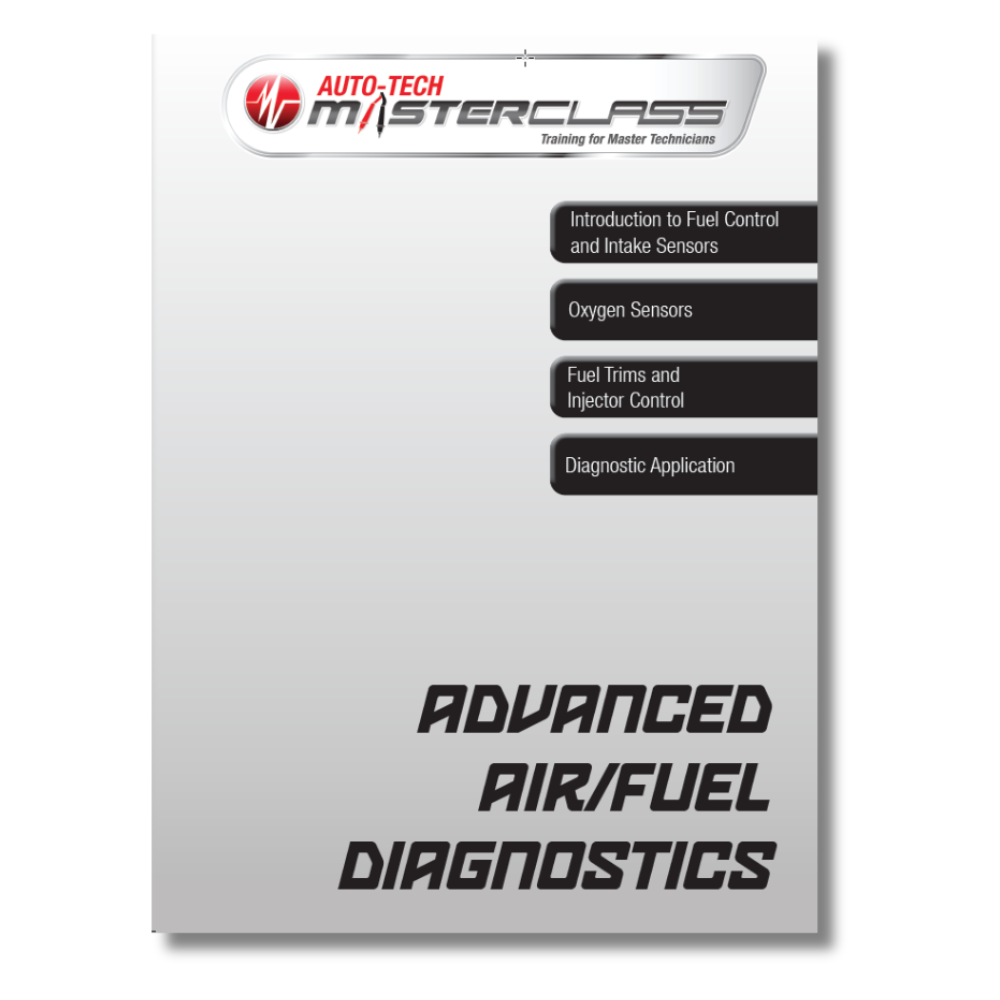
Advanced Air/Fuel Diagnostics
AutoTech 2025.3 Training Manual
Modern engines are no longer simple fuel-and-spark systems. With MAF-centric, Speed-Density and Hybrid strategies, wide-band oxygen sensors, adaptive fuel trims and high-pressure direct injection, accurate diagnosis requires deep system understanding — not guesswork.
The Advanced Air/Fuel Diagnostics Training Manual delivers exactly that.
Designed for professional technicians and advanced apprentices, this manual bridges the gap between theory and real-world workshop application, equipping you with structured diagnostic strategies you can apply immediately.
What’s Included
Fuel Injection Control Strategies
- MAF-centric systems
- Speed-Density systems
- Hybrid/Dual Sensor systems
- ECU input weighting for MPI & DPI
- Understanding how the ECU prioritises sensor data
MAF & MAP Sensor Diagnostics
- Hot-wire, Hot-film & Multifunction MAF sensors
- Bosch HFM-8 systems
- MAP vs Boost sensor differences
- Sensor drift & contamination diagnosis
- KOEO & idle quick checks
- Barometric pressure reference tables
- Peak Calculated Load testing
- Absolute Load vs Calculated Load explained
- Linear RPM vs MAF validation
Practical tests are clearly explained with real scan data comparisons.
Oxygen Sensor Systems
Narrow-Band Sensors
- Nernst cell fundamentals
- Cross-count analysis
- Switching frequency testing
- Emissions impact interpretation
Wide-Band & AFR Sensors
- Closed & open diffusion chamber designs
- 4-wire single-cell wide-band operation
- Pump current control logic
- Micro-amp scope testing
- Heater control strategies
- EOBD monitor functionality
- Air/Fuel imbalance detection
- FAOSC (Fore/Aft Oxygen Sensor Control)
- DTC-to-fault reference charts
Fuel Trim Strategy & Interpretation
- Short-Term Fuel Trim (STFT) behaviour
- Long-Term Fuel Trim (LTFT) adaptation
- OEM-specific strategies (GM, Bosch, Toyota, Honda, etc.)
- Cell-based vs State-based systems
- Fuel trims as multipliers
- SAE J1979 Mode $01 PID alignment
- When and how to perform fuel trim resets
Learn how to interpret fuel trims correctly — and avoid common diagnostic mistakes.
Fuel Injector Control & Waveform Analysis
Port Fuel Injection (PFI)
- Saturation control
- Current ramp analysis
- Pintle hump identification
- Voltage spike interpretation
- MOSFET vs BJT control differences
Direct Petrol Injection (DPI)
- Peak & Hold strategy
- High-voltage DC/DC converter operation
- Dual-sided injector control
- Charging, Peak & Hold phases
- Current and voltage waveform breakdown
Includes oscilloscope interpretation guidance to remove confusion around DPI waveforms.
Scan Tool & Diagnostic Testing
- Injector balance testing
- Rail pressure drop testing
- GM GDS2 balance command
- Interpreting Enhanced vs EOBD data
- Avoiding scan data bottlenecking errors
Real-World Diagnostic Case Study
A complete end-to-end diagnostic walk-through featuring:
- DTC P0172 & P0175 rich condition diagnosis
- Failure record interpretation
- MAF validation using Peak Calculated Load
- Wide-band oxygen sensor responsiveness testing
- Fuel density & ethanol testing
- Injector balance comparison testing
- Mechanical verification procedures
- Final resolution and verification
This case study demonstrates structured diagnostic thinking — not parts replacement guessing.
Who This Manual Is For
- Automotive technicians
- Diagnostic specialists
- Workshop foremen
- Advanced apprentices
- Technical trainers
- Anyone diagnosing modern petrol drivability faults
Why You Need This Manual
Modern air/fuel systems are adaptive, complex and highly integrated. Without a structured approach, misdiagnosis is common and costly.
This training manual gives you:
✅ Clear explanations of complex systems
✅ Practical workshop test procedures
✅ Scan tool and oscilloscope guidance
✅ OEM strategy comparisons
✅ Real-world application examples
✅ Confidence in diagnosing rich, lean and imbalance faults
The Advanced Air/Fuel Diagnostics – AutoTech 2025.3 Training Manual equips you with the knowledge and diagnostic structure required to confidently diagnose modern fuel control systems — from basic MAF faults to complex wide-band injector strategies.